By Ben Beichner, Direct Support Professional and Founder of Hourly Goal
An open shift appears on the schedule. Is picking up an extra nursing shift worth it? You could earn more, but you might also sacrifice recovery time, pay for childcare, or rearrange family plans. Before saying yes, there’s a practical question: How much of that extra shift’s pay might you actually keep?
You don’t need a perfect prediction to make a better decision. You do need to separate what you know, what you’re estimating, and what remains uncertain.
Start With the Extra Shift’s Gross Earnings
Consider a fictional nurse earning $25 per hour who has already worked 40 hours in a workweek. Assume the nurse is eligible for time-and-a-half overtime, and an additional eight-hour shift qualifies.
The arithmetic is straightforward:
- Regular hourly rate: $25
- Overtime rate: $25 × 1.5 = $37.50
- Additional shift: 8 hours
- Additional gross earnings: $300
This is a teaching example, not a statement that every nurse receives overtime after 40 hours. Under federal law, covered, nonexempt employees generally earn at least time-and-a-half their regular rate after 40 hours in a workweek. Special healthcare arrangements, exemptions, state rules, and employment agreements can affect the calculation. Shift differentials and certain bonuses may also change the applicable regular rate. Check your employment terms and payroll information before assuming a multiplier.
Why Overtime Gross Pay Is Not Take-Home Pay
The $300 figure is gross pay, not automatically $300 available to spend. Paychecks can reflect income-tax withholding, Social Security and Medicare taxes, insurance contributions, retirement contributions, and other deductions.
For illustration, suppose the worker uses a 20% combined deduction assumption for the additional earnings:
- Gross extra-shift pay: $300
- Illustrative 20% deductions: $60
- Simplified estimated amount remaining: $240
That $240 is only an arithmetic estimate. It is not an effective tax-rate claim or a guarantee of the employee’s actual additional paycheck deposit. Withholding elections, overall wages, benefits, and payroll practices can change the result. An employee’s actual deductions may not increase in the same proportion as gross earnings.
If you do not have a reasonable deduction estimate, keep take-home pay marked as unknown rather than inventing a precise figure.
How Hourly Goal Can Help You Explore the Numbers
Hourly Goal is a free web tool built to help hourly workers examine paycheck and extra-shift scenarios.
Its Quick Extra-Shift calculator accepts an hourly rate, shift length, and selected pay type. In the fictional example above, entering $25 per hour, eight hours, and a 1.5× overtime multiplier produces $300 before taxes. Selecting the optional estimated-deductions setting and entering 20% displays $240 after estimated taxes and deductions.
The tool explicitly says it does not determine overtime eligibility, and its estimates should not be treated as guaranteed paycheck amounts. Users can also choose to explore how a shift could affect a broader financial plan. That planning step is useful only if the pay schedule and assumptions entered are realistic.
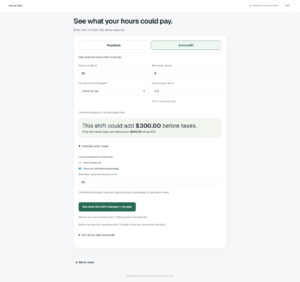
Hourly Goal’s Quick Extra-Shift calculator showing a fictional $25/hour, eight-hour overtime shift: $300 gross and $240 remaining under an assumed 20% deduction rate. Actual pay may vary.
Check the Payday, Not Just the Pay Rate
When a bill is due soon, a useful question is not only “How much will I earn?” but also “When will those earnings arrive?” Is picking up an extra nursing shift worth it?
Confirm the payroll cutoff and expected payday. A shift worked this week may not appear in the deposit you have in mind. Compare the estimated amount with the due date of the expense you’re trying to cover.
Then subtract any extra costs of taking the shift: commuting, parking, meals, or childcare. Those costs can make a seemingly attractive shift less valuable.
Factor In Rest, Safety, and Your Schedule
Financial tradeoffs are not the entire story. Nursing can be physically and emotionally demanding, and additional hours may affect sleep, recovery, and personal responsibilities.
Before accepting, consider whether the expected financial benefit justifies the extra time and strain. The answer may change depending on your schedule, obligations, and how urgently you need the additional income.
Make the Decision with Clearer Information
A useful shift decision begins with gross earnings, moves to a cautious take-home estimate, checks the pay date, and accounts for additional costs and recovery time.
The goal is not to accept every available shift. It’s to understand what an extra shift could realistically accomplish before committing to it.
Founder disclosure: Ben Beichner is the founder of Hourly Goal and works as a direct support professional. This article is educational, not individualized tax, payroll, legal, or financial advice.