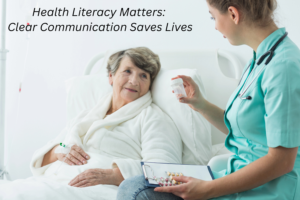
In modern healthcare, clinicians rely on advanced technology, innovative treatments, and evidence-based practice to improve patient outcomes. Yet one of the greatest barriers to effective care is far less visible: healthcare illiteracy. Many patients struggle to understand medical information, instructions, and even basic terminology used during clinical encounters. As a result, they may leave healthcare settings confused, overwhelmed, or unable to follow their care plan.
Health literacy expert Helen Osborne has spent decades studying how communication affects patient understanding. Her work reminds healthcare professionals that the success of treatment plans depends not only on clinical expertise but also on the clarity of communication.
What Is Healthcare Illiteracy?
This is a subject near and dear to my heart as I have personally experienced the ramifications of poor patient education and nurse communication. Healthcare illiteracy—often referred to as low health literacy—occurs when individuals have difficulty obtaining, understanding, or using health information to make appropriate decisions about their care. This does not necessarily mean someone cannot read. In fact, many people who read well in everyday life struggle when confronted with medical language, complex instructions, or unfamiliar healthcare systems.
According to Osborne, health literacy is about mutual understanding between providers and patients. Communication is successful only when both sides truly understand each other.
In other words, the responsibility for clear communication does not rest solely with the patient—it is shared by healthcare professionals, educators, and healthcare organizations.
Why It Matters in Nursing and Healthcare
Healthcare illiteracy can have serious consequences. Patients who misunderstand instructions may take medications incorrectly, miss follow-up appointments, or fail to recognize warning signs of complications. In chronic disease management, misunderstanding a treatment plan can mean the difference between stability and hospitalization.
Nurses are often the front-line communicators in healthcare. They explain medications, review discharge instructions, and answer questions from patients and families. When patients do not fully understand these explanations, the effectiveness of nursing care can be diminished.
Osborne’s work highlights that the problem is not always patient capability—it is often the complexity of healthcare communication itself. Medical jargon, rushed explanations, and information overload can easily overwhelm patients who are already anxious or in pain. Simplification is essential.
The Role of Clear Communication
One of Osborne’s key messages is that healthcare communication must be designed for understanding. In her book Health Literacy from A to Z: Practical Ways to Communicate Your Health Message, she provides practical strategies for making health information easier to understand. The book emphasizes the importance of plain language, thoughtful organization of information, and communication techniques that prioritize patient comprehension.
Simple strategies can make a powerful difference. For example:
- Use plain language instead of medical jargon.
- Break information into small, manageable pieces.
- Use visuals or diagrams to explain conditions and treatments.
- Encourage questions and patient participation.
Osborne also highlights the value of visual communication. In one example, a patient better understood his heart condition after seeing a simple drawing illustrating blocked arteries. Visual aids like diagrams or illustrations can transform abstract medical explanations into understandable information.
The Teach-Back Method
Another approach widely recommended in health literacy work is the “teach-back” method. Rather than asking patients, “Do you understand?” clinicians ask them to explain the instructions in their own words. This approach confirms whether the message was clearly communicated. This is something nurses learn early on in the education, but in times of stress and overwhelm, it isn’t always used as it should be.
For example, instead of asking a patient if they understand their medication instructions, a nurse might say:
“Just so I know I explained this clearly, can you tell me how you will take this medication when you get home?”
This technique removes blame and shifts responsibility to the communicator to ensure clarity.
Creating a Culture of Health Literacy
Improving health literacy is not just an individual responsibility—it is an organizational one. Healthcare systems must design materials, instructions, and communication practices that prioritize understanding. Osborne’s work encourages healthcare organizations to evaluate their written materials, websites, signage, and patient education resources to ensure they are accessible and easy to use. It’s important however, not to rely solely on written materials. Handing a patient a pamphlet and expecting him to have the best outcomes is not reasonable. Reading tjrough it with him and explaining and using teach-back methods, will help improve outcomes.
For nurses and other clinicians, the goal is not to simplify medical care, but to simplify communication.
Moving Forward
Healthcare illiteracy remains an underrecognized barrier to effective care. Patients may feel embarrassed to ask questions or admit confusion, which makes it even more important for healthcare professionals to communicate clearly and compassionately. And to carry the burden of clear communication, allowing the patient to not have to assume the role of not understanding.
As Helen Osborne’s work reminds us, clear communication is not an optional skill in healthcare—it is a core component of safe, effective patient care. When nurses and healthcare professionals take the time to ensure understanding, they empower patients to become active participants in their health.
In the end, improving health literacy benefits everyone. Patients gain confidence and clarity, clinicians see better adherence to care plans, and healthcare systems move closer to their ultimate goal: delivering care that truly improves lives.